
A response to The Harper Review’s Winter 2026 proposition, “The party is over.”
Dear editors,
I originally wrote a letter about Christianity, capitalism, and the turn, by both the early church and modern-day communists, away from revolution and towards Armageddon. In both cases, morbid prognostications on when the party might end really killed the vibe (much like realizing you only have thirty minutes left at Rascal’s Fun Zone for your twelfth birthday party and cry in the corner instead of sprinting toward one last game of Sea Wolf: The Next Mission).
In truth, I am not much of a Christian or a communist. My time in both of these parties has likely run its course. I am, however, an intellectual. And many today insist that the age of intellectualism—that is, of thinking—has come to an end. American minds are closing. The Flynn effect is reversing. Artificial intelligence will outsource consulting jobs (what?). Whether due to late-stage capitalism, cultural decadence, social media algorithms, or the slow hemorrhaging of university funding, prophecies of the intellectual End Times surround us.
It may well be that some, or even all, of these prophecies will come to pass. But none of them interest me much. After all, the world will end, one way or another. The appeal of such nihilism arises, as Hannah Arendt once said, “out of the desire to find results which would make further thinking unnecessary.” But I like thinking. These fantasies of Hell seem therefore utterly masochistic. “What hedonism!” some of you surely cry, “to turn one’s mind away from truth for pleasure’s sake!” But I insist that before the party’s over, there’s no other way. “The intelligence,” as Simone Weil would put it, “can only be led by desire.” Only pleasure, in its highest and most intense form, leads to truth.
But if this is true, then you, dear reader, engulfed yet unmoved by the greatest party yet conceived—with boba vending machines, AI lovers, and all the world’s great literature waiting for you in LibGen—are in need of further reproach. Charles Baudelaire was correct in observing that among all the snarling, lechering vices, boredom is by far the worst: “This obscene beast chain-smokes yawning for the guillotine.” And so we eagerly await our own beheading today. The real catastrophe might be that modernity has finally proven human beings too weak to pursue their own desires: that a good conscience demands the replacement of flesh by chastened thinking machines. What else to make of “you—hypocrite reader—my double—my brother” wasting away in this drunk world?
Alas, I am doing it again, trying to count the hours of the doomsday clock. But this time it is instructive. Endemics of ennui infect the elite of every advanced culture. Its cure is found only in the act of thinking itself: that circular, paralyzing, invigorating practice of Socrates. Philosophy, as he would say, is the best practice we have for dying. It is the most vital (in both senses of the word) party there is. Even this party will end eventually, but all the hand-wringing about how and why and when and if maybe there’s an after-party somewhere is just another way of clinging to finality before its time.
Comrades! Hold fast in faith and harden not your hearts! All too often, the party’s over only as soon as we believe it to be.
Intractably,
Liam Eifert
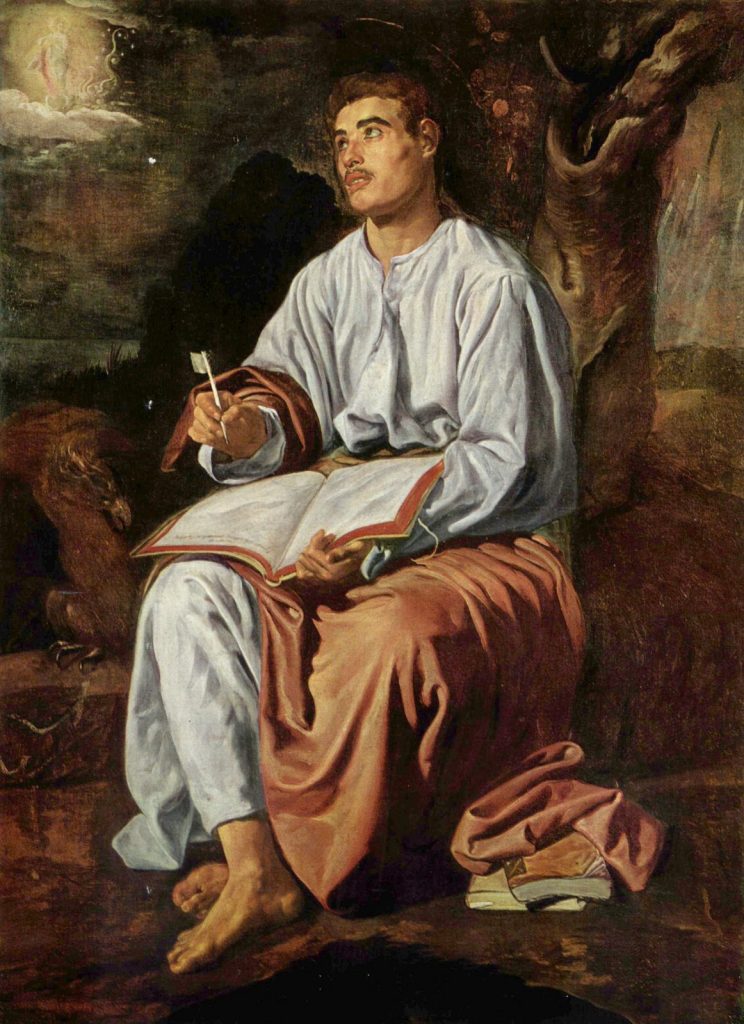
Image: Diego Velázquez, Saint John the Evangelist on the Island of Patmos, oil on canvas, 1618–19 (National Gallery, London, United Kingdom).