
Dear editors,
“It’s all about sex.” It’s a tagline and mantra. Sex sells, dominates, and defines us. The aphorism has been recycled so often it now reeks of tired familiarity.
It would be easy to dismiss our culture’s obsession with sex as sensationalism—just another tactic aimed at capturing our attention spans. But the constant undercurrent that laces every conversation, marketing campaign, and first date makes me wonder if it’s the other way around. What if the phrase was inverted? What if it’s not “all about sex,” but rather that sex is all about something else?
It’s not just that we love sex, but rather that we have come to love desire itself. The world accepts the commodification of bodies. The marketplace of the human body is perpetually open for business, its products on display in browser windows or social media feeds illuminated with electronic lust. Desire is the currency; sex is merely the transaction. The result? A hollowed out, commercialized version of sex that fails to live up to the seductive fantasy we have crafted for it.
Most people never question this fantasy, but philosopher Amia Srinivasan has interrogated the nature of desire: what if we don’t want what we think we want? Srinivasan’s work challenges us to dismantle the idea of “authentic” desire, writing in her book The Right to Sex: Feminism in the Twenty-First Century, “[t]he roles we play, the emotions we feel, who gives, who takes, who demands, who serves, who wants, who is wanted, who benefits, who suffers: the rules for all this were set long before we entered the world.” We claim to desire the intimacy, connection, pleasure of sex. But how much of that desire is genuinely ours? How much of it have we been taught to want as Pavlovian subjects?
Something feels stagnant about our cultural engagement with sex. Each new iteration of the “it’s all about sex” narrative—whether “progressive” or “empowered”—still operates within the same narrow frameworks of heteronormativity, patriarchy and capitalism. Yes, autonomy and empowerment exist, but only within a system that reinforces the very structures it purports to question.
The only thing that’s truly free in our conception of sex is exchange itself. We are free to commodify our bodies, identities, and desires. Perhaps sex is closer to an afternoon in a shop rather than an evening in the bedroom. Are we not willing participants of a market exchanging self-commodification for the commodification of others? The paradox, of course, is that the narrative of “sexual freedom” brings us no closer to the connection we crave.
Perhaps it’s time to start questioning whether sex is a reflection of something that has yet to be properly articulated. What if sex is not all about sex, but rather reflects desires we’re afraid to explore and truths that we’re afraid to confront? Sex is not an invitation to simple pleasure, but instead to a deeper understanding of what it means to be embodied as a human living in a world that refuses to tell us the whole truth about desire.
There’s a cruel irony here. Sex is treated as a form of freedom, when in reality, it’s another set of chains. In the tragic search for liberation, it’s forgotten that true freedom isn’t found in the transaction. It’s found instead in the act of questioning the currency and authority of the illegitimate state to which we’ve found ourselves subjected.
Skeptically,
Shawn Quek
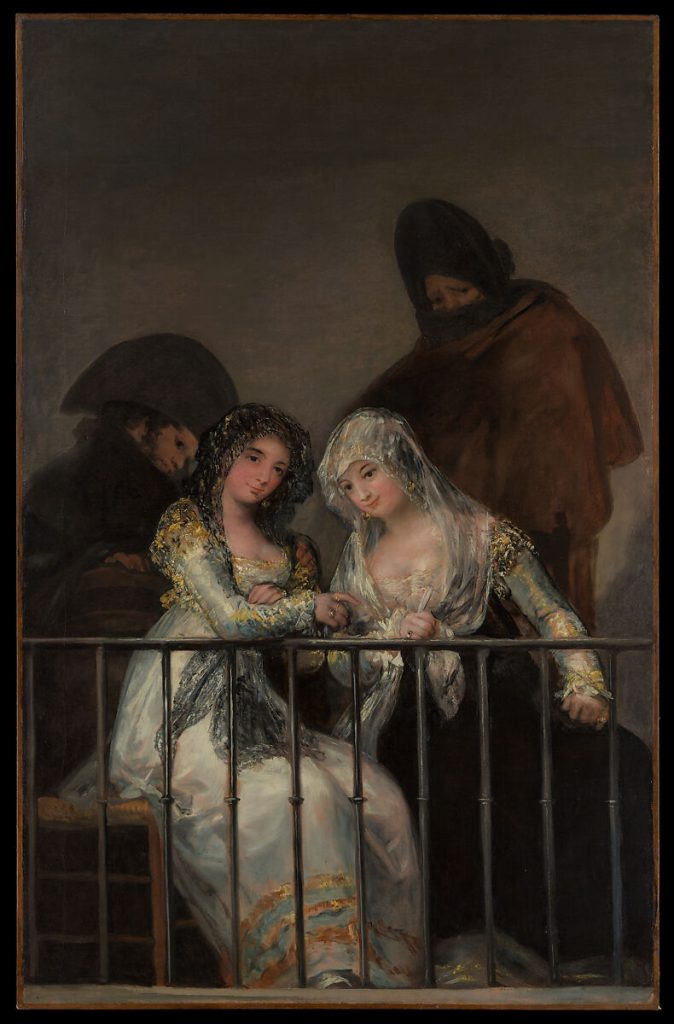
Image: Francisco de Goya y Lucientes, Majas on a Balcony, oil on canvas, ca. 1800–1810, (Metropolitan Museum of Art, New York).