
A response to The Harper Review’s Winter 2026 proposition, “The party is over.”
Dear editors,
A party is when collective emotion comes together to destroy the individual identities of partygoers. Everyone and everything becomes the party: lighting, intoxicants, furniture, temperature, and noise. Ethereal and finite, parties are moments where joy, chaos, and understanding unleash a collective effervescent whirlwind.
Love is a bit like a party. We dissolve the membrane of our identity in another’s presence such that words are not needed for understanding; we ride an emotional rollercoaster two-seater, through joy especially, but through sadness, rage, and apathy, too; we stretch ourselves thin with no regard to an ending. What better way to prevent the end of a party than by believing it never will? But work and school must be attended, friends and family attended to, and so the party cannot last.
When you’re in the thick of the party you don’t think about why you love someone, you just do. But after the fact? When grey morning light spears the pupils of your eyes, how do you continue?
When Harry Met Sally offers an answer. As they leave a party, Harry tells Sally:
I love that you get cold when it’s 71 degrees out, I love that it takes you an hour and a half to order a sandwich, I love that you get a little crinkle above your nose when you’re looking at me like I’m nuts, I love that after I spend a day with you I can still smell your perfume on my clothes, and I love that you are the last person I want to talk to before I go to sleep at night.
In spite of how annoying these things may seem, Harry loves Sally because of them. He is able to love her deeply because he is able to observe her just as deeply—something only possible in sober, post-party clarity.
Harry and Sally’s relationship poses a solution to the often fragile and volatile ending of the “party” phase: when the disco stops and daylight presents itself, use it to observe. When the music quiets and words present themselves, use them to love.
An individual willing to observe creates a love that is rooted in reality and grounded in details, like an artist who must first study their scene. The artist communicates their observations through detailed brushstrokes; we convey our love through specific words. To love is not just to see, but to affirm, carefully and in the daylight.
While the whirlwind of party love is visceral, physical, and miraculously intimate in its own way, post-party love is as richly rewarding and long-lasting as the effort put into it. To have the honor to observe another person through ecstasy and mundanity, and then to refine the right words to show how much you love and accept them, is worth every hangover and doubt after the party is over.
Dearly,
Mimi Mikhailov
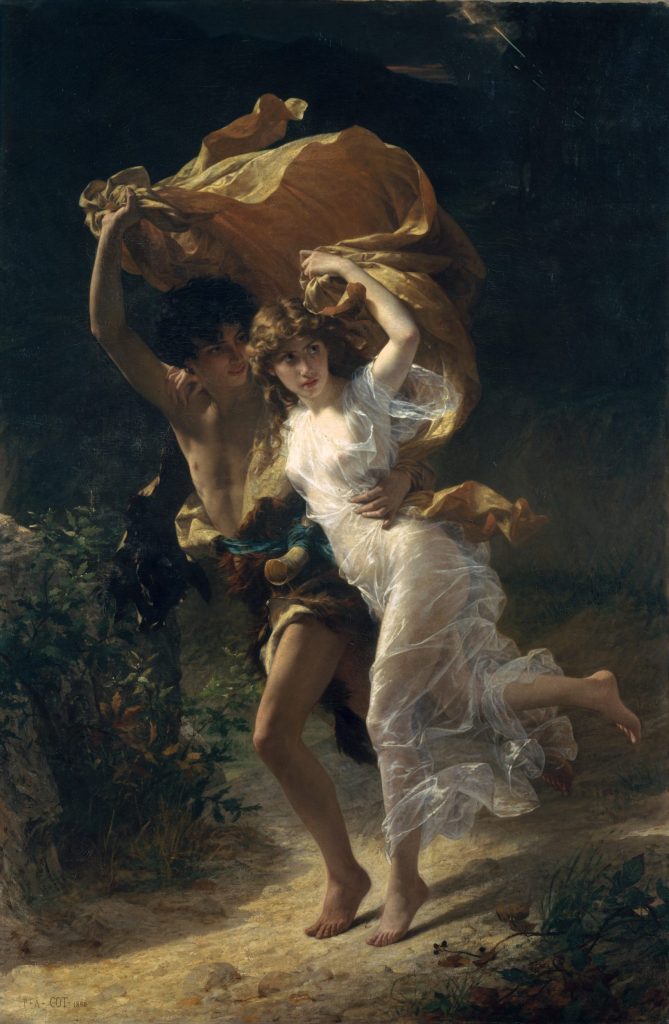
Image: Pierre-Auguste Cot, The Storm, oil on canvas, 1880 (Metropolitan Museum of Art, New York).