
Carter’s diagnosis: Last weekend, President Jimmy Carter died at the age of 100. In the flood of memorials that have followed, journalists, historians, and politicians have pointed again and again to one of President Carter’s most famous moments, his speech on America’s “Crisis of Confidence”—which he termed a “turning point” in his presidency. Beset by an energy crisis, ravaged by Vietnam and Watergate, and reeling from the assassinations of Dr. Martin Luther King Jr. and the Kennedys, Americans were paralyzed by “the growing doubt about the meaning of our own lives and in the loss of a unity of purpose for our nation.”
Carter’s point, however, was not that the troubles of the past had doomed the present. Instead, shaken by the past, Americans had lost confidence in the future: “The erosion of our confidence in the future is threatening to destroy the social and the political fabric of America… Confidence in the future has supported everything else—public institutions and private enterprise, our own families, and the very Constitution of the United States.” The crisis in American society—its materialism, its distrust, its discontent—was the product of hopelessness. Citizens and their government had to work together to restore the promise of the future, and they had to keep their faith in that promise. The past was past. The future lay open.
Carter’s point, however, was not that the troubles of the past had doomed the present. Instead, shaken by the past, Americans had lost confidence in the future: “The erosion of our confidence in the future is threatening to destroy the social and the political fabric of America… Confidence in the future has supported everything else—public institutions and private enterprise, our own families, and the very Constitution of the United States.” The crisis in American society—its materialism, its distrust, its discontent—was the product of hopelessness. Citizens and their government had to work together to restore the promise of the future, and they had to keep their faith in that promise. The past was past. The future lay open.
Noah Glasgow, editor in chief
A winter’s tale: Eugene Onegin—a young scapegrace and man-about-town—has it all: good looks, money, and a place atop the dazzling height of Saint Petersburg’s most fashionable society. But lately he’s sickened of the social whirl. Concerts and fêtes bore him and the attentions of the Petersburg beauties leave him cold. After inheriting his uncle’s rural estate, he flees to the countryside where he meets Vladimir Lensky, an eighteen-year-old poet and romantic recently returned from his studies in Germany. Onegin and Lensky become fast friends, idling away their time together until a fit of petty spite leads to fatal consequences.
Written in specialized sonnets, Eugene Onegin is a marvel of narrative economy and thematic scope. In just eight short chapters, Pushkin captures nearly all of life’s joys and sorrows: the thrill and ultimate emptiness of le beau monde, the pleasures of the countryside, the splendor of the Russian winter, the ecstasy of young love, and the murderous fury of offended honor among them. Pushkin relates all of this in a voice that flits from complete detachment to impassioned intimacy, taking seriously the suffering of his characters while simultaneously suggesting that all of life is, in the end, much ado about nothing.
Written in specialized sonnets, Eugene Onegin is a marvel of narrative economy and thematic scope. In just eight short chapters, Pushkin captures nearly all of life’s joys and sorrows: the thrill and ultimate emptiness of le beau monde, the pleasures of the countryside, the splendor of the Russian winter, the ecstasy of young love, and the murderous fury of offended honor among them. Pushkin relates all of this in a voice that flits from complete detachment to impassioned intimacy, taking seriously the suffering of his characters while simultaneously suggesting that all of life is, in the end, much ado about nothing.
Will Dudley, contributing editor
Stinking rich: From Aristotle to the present, critiques of wealth have been an institutional component of social thought—and according to Guido Alfani’s recent book, As Gods Among Men: A History of the Rich in the West, it is at the core of the Western intellectual tradition. Alfani, recently profiled in Jacobin magazine, argues that suspicion of the wealthy is a formative intellectual virtue to Western thought, from Aristotle and Aquinas onward. At every point of upheaval, philosophers and thinkers consistently point fingers at the wealthy and pay close attention to the proximity of wealth and power. Particularly key to social thought is the suspicion of wealth influencing governance, resulting in pitchforks and popular revolutions. Alfani posits that whenever power and wealth become too closely connected, government ceases to be effective for the average citizen. As such, Alfani concludes that criticism of wealth is not only a core part of our received intellectual tradition but a necessary line of defense against an inevitable social problem, in ancient days as well as our own.
Brady Santoro, assistant editor
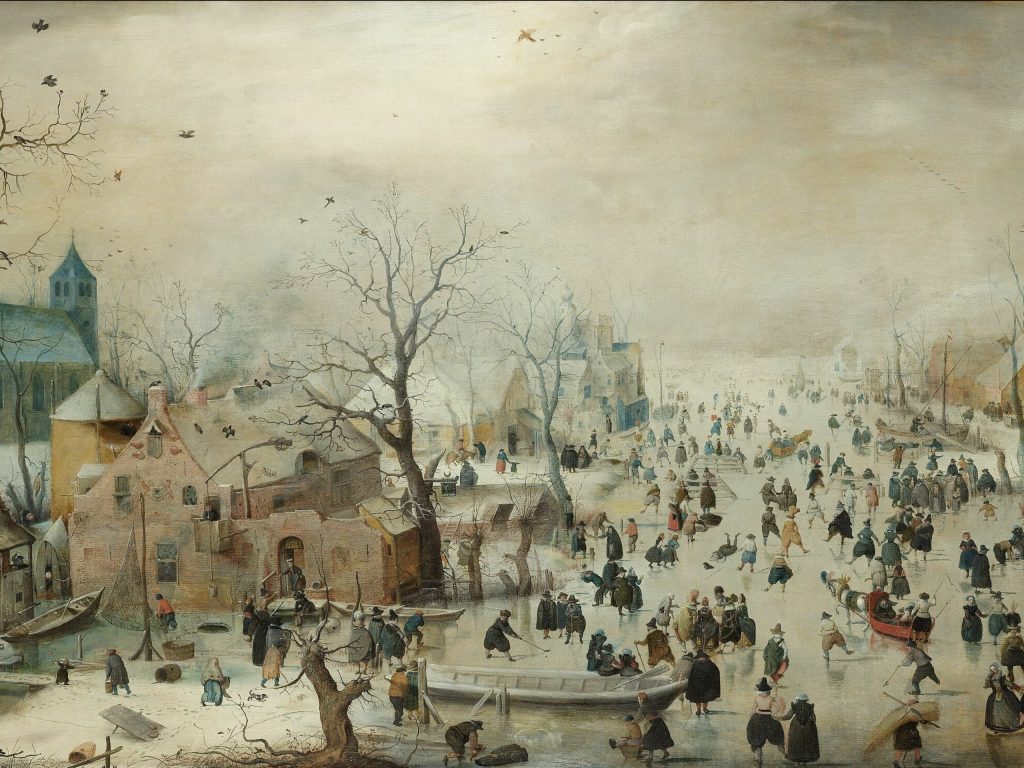
Image: Hendrick Avercamp, Winter Landscape with Ice Skaters, oil on panel, 1608 (Rijksmuseum, Netherlands).