
Letter from the editor: The Code of the Woosters by P. G. Wodehouse), the butler Jeeves invokes Keat’s famous poem, “To Autumn”: “If you will recollect, we are now in Autumn—season of mists and mellow fruitfulness.” In addition to the ‘winnowing wind,’ the ‘stubble-plains,’ and ‘the moss’d cottage trees,’ with autumn comes a new year of The Harper Review. Since 2023, the Review has served as an intellectual and social outlet for students at the University of Chicago (and elsewhere), publishing criticism and hosting events like quarterly parties and symposia.
This year, we plan to expand our community. In addition to the regular fare, we’ll host more social and intellectual events, including an autumnal gathering at Promontory Point, a winter speaker event, a reprise of our spring symposium, and a recurring book and essay club based on the Review’s letters prompts. The past few years at UChicago have been tumultuous: the school has faced enormous challenges like the encampment, the restructuring of the Arts & Humanities Division, and the changing role of universities under the Trump administration. To address the growing demand for clear and thoughtful analysis of the situation, the Review will publish a biweekly op-ed or piece of original reporting, featured here and online, from our editorial staff. Our first such column, written by senior editor Brady Santoro, is below.
The Harper Review is confident that these new additions will enrich the culture of both the magazine and of the University at large. In any case, we remain a publication that strives for intellectual seriousness and is eager to address the questions of the day with bold, well-reasoned answers.
Elizabeth Eck, editor in chief
Trigger warning: The Harper Review’s fall letter prompt, “We should still believe in progress,” comes with an implicit hedge. Its positive spin preempts what we see as dour prospects for progress when prevailing attitudes are accelerationist or doomer, with little fuel or fervor for in-betweens. Wading into this mess, Sophia Gutierrez diagnoses our political disillusionment with a cyclical case of personal and public traumas, injecting the therapeutic buzzword of a coddled generation with a dose of reality.
Emily Sun, senior editor
Conflict zones: In May 2007, Iraqi-born artist Wafaa Bilal constricted himself to a small room at the FlatFile Galleries in Chicago for the entire month. Bilal set himself on a constant livestream and placed a remote-controlled paintball gun facing his new living space. There, he would go about a mundane life until someone, anywhere in the world, decided to disrupt him. Anonymous viewers had sole discretion over the machine, offloading paintball shots with an effortless click on their computer screens. Bilal fled from Saddam Hussein’s regime in 1991, joining a growing community of Iraqi intellectuals cut off from their homeland by political persecution. From his exile in America, he witnessed the Iraq War claim the lives of his family members as U.S. Army officers, just miles away, launched missile strikes on Iraq from computer screens.
The room, the livestream, the paintball machine, the sleepless nights mandated by the digital, crowdsourced bang of a paintball: it was all an exercise in the arbitrariness and automation of violence. Bilal used his body and his audience as the instruments of his art to demonstrate how modern weapons of war distance perpetrators from their human cost. Open until this Sunday, October 19, the Museum of Contemporary Art Chicago’s Wafaa Bilal: Indulge Me is the first major survey of Bilal’s oeuvre. An archival display of Domestic Tension (2007) is on view, along with another year-long performance 3rdi (2010–11) and two new works.
The room, the livestream, the paintball machine, the sleepless nights mandated by the digital, crowdsourced bang of a paintball: it was all an exercise in the arbitrariness and automation of violence. Bilal used his body and his audience as the instruments of his art to demonstrate how modern weapons of war distance perpetrators from their human cost. Open until this Sunday, October 19, the Museum of Contemporary Art Chicago’s Wafaa Bilal: Indulge Me is the first major survey of Bilal’s oeuvre. An archival display of Domestic Tension (2007) is on view, along with another year-long performance 3rdi (2010–11) and two new works.
Elena Eisenstadt, contributing editor
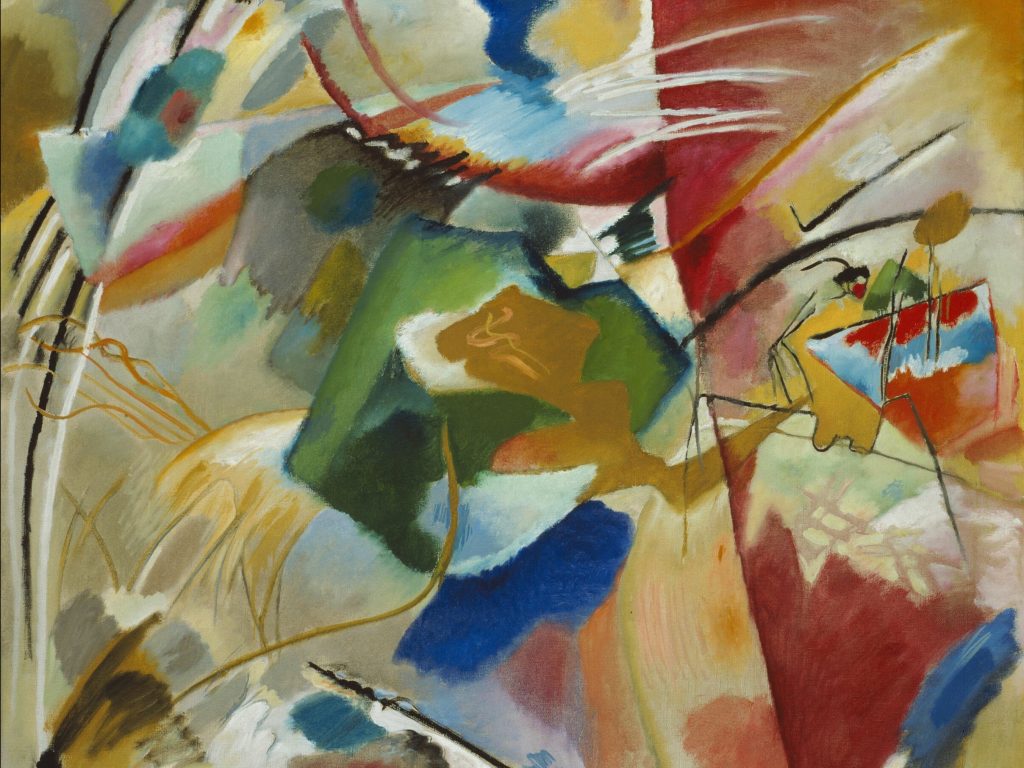
Image: Vasily Kandinsky, Painting with Green Center, oil on canvas, 1913 (Art Institute of Chicago, Illinois).